Quick Reference - Key Specifications
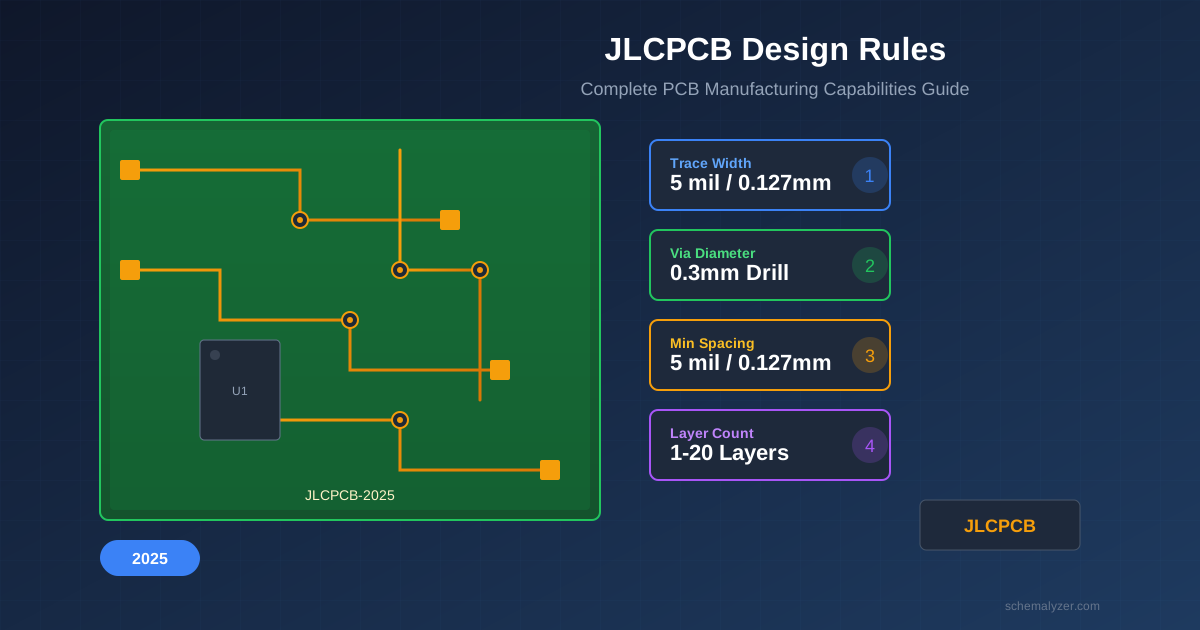
Min Trace/Space:5 mil (2L), 3.5 mil (4-6L)
Min Via:0.45mm dia, 0.2mm drill
Board Size:5x5mm to 400x500mm
Layers:1-20 layers supported
Thickness:0.4mm to 2.0mm
Copper:0.5oz, 1oz, 2oz
Introduction: Why Design Rules Matter
Every PCB manufacturer has unique capabilities and limitations. JLCPCB, as one of the world's largest prototype PCB manufacturers, processes millions of orders annually - and has optimized their production lines for specific design parameters.
Understanding these design rules isn't just about avoiding rejections. It's about:
- Maximizing yield: Designs within capabilities have fewer defects
- Minimizing cost: Standard specs avoid “special process” fees
- Faster turnaround: No back-and-forth for DFM fixes
- Predictable quality: Know what to expect from production
This guide consolidates all JLCPCB specifications into one comprehensive reference. Bookmark it for your next design.
Specifications Change
JLCPCB regularly updates their capabilities. This guide reflects specifications as of late 2025. Always verify critical parameters on JLCPCB's official capabilities page before finalizing designs.
Trace Width & Spacing Specifications
Trace width and spacing (clearance) are the most fundamental design rules. They depend on your layer count and copper weight.
2-Layer Boards
| Copper Weight | Min Trace Width | Min Spacing | Notes |
|---|---|---|---|
| 1 oz | 5 mil (0.127mm) | 5 mil (0.127mm) | Standard, no extra cost |
| 2 oz | 8 mil (0.2mm) | 8 mil (0.2mm) | Required for heavy copper |
4-Layer Boards
| Layer | Copper Weight | Min Trace/Space |
|---|---|---|
| All Layers | 1oz outer / 0.5oz inner | 4 mil (0.1mm) |
| Inner Layers | 2oz outer / 0.5oz inner | 4 mil (0.1mm) |
| Outer Layers | 2oz outer / 0.5oz inner | 8 mil (0.2mm) |
6+ Layer Boards
| Layer Count | Min Trace/Space | Notes |
|---|---|---|
| 6 Layer | 3.5 mil (0.09mm) | Tightest standard spec |
| 8-20 Layer | 3.5 mil (0.09mm) | Same as 6-layer |
| Ultra-fine (special) | 3 mil (0.076mm) | Available for limited traces |
Extra Charges
Using 3.0-3.5 mil trace/space on multilayer boards incurs extra fees: +20% for 4-8 layers, and +30% for 10+ layers.
Design Recommendations
- Standard designs: Use 6 mil trace/space for 2-layer boards - leaves margin for manufacturing variation
- High-density: 4 mil is achievable on 4-layer without extra cost
- Always wider when possible: Thinner traces have lower yield and conductivity
Via Specifications
Via parameters vary significantly between 2-layer and multilayer boards due to different drilling technologies.
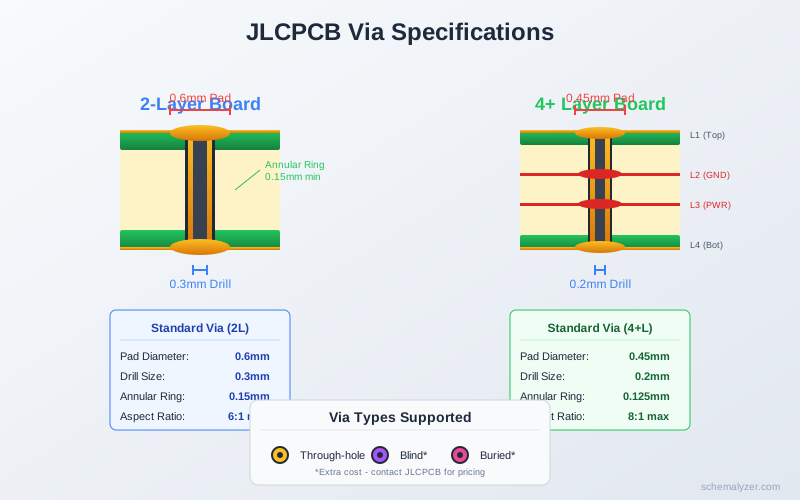
Via Size Requirements
| Parameter | 2-Layer | 4+ Layer |
|---|---|---|
| Min Via Pad Diameter | 0.6mm (24 mil) | 0.45mm (18 mil) |
| Min Drill Diameter | 0.3mm (12 mil) | 0.2mm (8 mil) |
| Via-to-Via Clearance | 0.254mm (10 mil) | 5 mil (0.127mm) |
| Hole Clearance | 0.25mm | 0.25mm |
Annular Ring
The annular ring is the copper ring around a drilled hole. For reliable vias:
- Minimum annular ring: 0.15mm (6 mil)
- Recommended: 0.2mm (8 mil) or larger for better reliability
- Formula: Annular Ring = (Pad Diameter - Drill Diameter) / 2
Via Types Supported
Through-Hole Vias
Standard support for all layer counts. Goes through entire board.
Via-in-Pad (POFV)
Free for 6-20 layer boards. Resin-filled and capped with copper.
Blind/Buried Vias
NOT supported in standard production. Through-holes only.
Aspect Ratio Consideration
Aspect ratio = Board Thickness / Drill Diameter. Higher ratios are harder to manufacture. For reliable plating, keep aspect ratio under 10:1.
Hole Sizes & Drilling
JLCPCB uses mechanical drilling for all hole types. Drill sizes increment by 0.05mm.
Drill Size Specifications
| Hole Type | Minimum | Maximum | Tolerance |
|---|---|---|---|
| PTH (Plated Through Hole) | 0.15mm | 6.3mm | +/-0.08mm (typical) |
| NPTH (Non-Plated) | 0.5mm | 6.3mm | +/-0.05mm |
| Metallized Slot | 0.65mm | - | +/-0.15mm |
| Non-Metallized Slot | 1.0mm | - | +/-0.15mm |
Small Holes (<0.3mm)
Holes smaller than 0.3mm are classified as “small holes” and may incur additional processing requirements:
- Higher aspect ratio challenges
- More difficult plating
- May require specific stackup configurations
Recommended Via Size for Most Designs
For standard 2-layer boards, use 0.8mm pad with 0.4mm drill. For 4-layer, 0.6mm pad with 0.3mm drill works well. These provide good reliability and avoid extra charges.
Layer Stackups (1-20 Layers)
JLCPCB supports PCBs from 1 to 20 layers. Odd layer counts (3, 5, etc.) are manufactured as the next even number.
Available Layer Counts
| Layers | Starting Price (5pcs) | Special Features |
|---|---|---|
| 1-2 Layer | $2 | Standard hobby prototypes |
| 4 Layer | ~$20 eng. fee | Most common multilayer |
| 6 Layer | $2 (promo) | Free ENIG, Free via-in-pad |
| 8 Layer | ~$82 | Free via-in-pad (POFV) |
| 10-20 Layer | $137+ | Via-in-pad included |
Standard Stackup Materials
- 1-6 layers: Standard FR-4
- 8+ layers: Sytech and Nanya materials
- High-frequency: Rogers, PTFE (Teflon) available
- Thermal: Aluminum core, Copper core options
Free Via-in-Pad for 6+ Layers
JLCPCB provides free resin-filled, copper-capped via-in-pad (POFV) for all 6-20 layer boards. This enables direct BGA fanout without extra cost.
Board Dimensions & Thickness
Board Size Limits
| Type | Minimum Size | Maximum Size |
|---|---|---|
| Single Board | 5mm x 5mm | 400mm x 500mm |
| V-Cut Panel | 70mm x 70mm | 400mm x 400mm |
| PCB Assembly | 10mm x 10mm | 470mm x 500mm |
Board Thickness Options
| Thickness | Price Impact | Restrictions |
|---|---|---|
| 0.4mm | Extra cost | ENIG only, no panelization |
| 0.6mm | Extra cost | Max 100x100mm, no HASL |
| 0.8mm - 1.6mm | Standard ($2 starting) | All finishes available |
| 2.0mm | Standard | All finishes available |
Tolerance: +/-10% of finished board thickness.
Most common: 1.6mm is the industry standard and most cost-effective option.
Copper Weight Options
Copper weight (measured in oz/ft²) determines trace current capacity and affects design rules.
| Copper Weight | Thickness | Min Trace/Space | Best For |
|---|---|---|---|
| 0.5 oz | 17.5 µm | 4 mil | Inner layers (multilayer) |
| 1 oz | 35 µm | 5 mil | Most designs (standard) |
| 2 oz | 70 µm | 8 mil | High current, power |
Note: 2oz copper requires wider traces because thicker copper is harder to etch precisely.
Surface Finish Options
Surface finish protects exposed copper pads and affects solderability, shelf life, and cost.
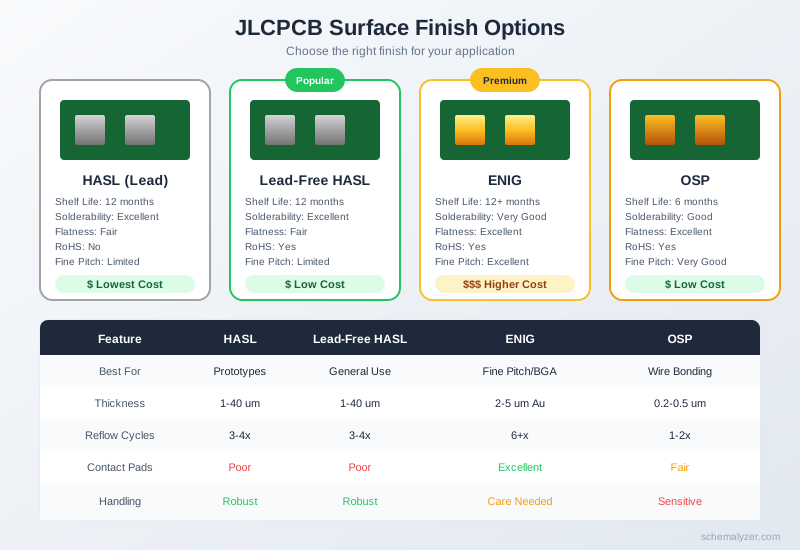
Available Finishes
| Finish | Cost | Pros | Cons |
|---|---|---|---|
| HASL (Lead) | Lowest | Durable, easy soldering | Uneven surface, not RoHS |
| Lead-Free HASL | Low | RoHS compliant, durable | Uneven, higher solder temp |
| ENIG | Higher | Flat, fine-pitch, long shelf | Cost, black pad risk |
| OSP | Low | Flat, RoHS, cost-effective | Short shelf life, fragile |
When to Use Each
- HASL: DIY projects, through-hole heavy boards, cost-sensitive
- Lead-Free HASL: Same as HASL but RoHS required
- ENIG: Fine-pitch ICs, BGAs, professional products
- OSP: Quick assembly, cost-sensitive, single reflow
Free ENIG for 6-Layer Boards
JLCPCB currently offers free ENIG (2u” gold thickness) on 6-layer boards as a promotional offer.
Solder Mask & Colors
Solder mask protects copper traces and prevents solder bridges during assembly.
Available Colors
Solder Mask Parameters
- Thickness: 16-30 micrometers (typical)
- Min solder mask dam: 0.1mm between pads
- Solder mask expansion: 0.05mm per side (typical)
Green = Fastest Turnaround
Green solder mask is optimized for fastest production. Choose green for quickest delivery when color doesn't matter.
Silkscreen Specifications
Silkscreen (legend) is used for component designators, polarity marks, and labels.
Silkscreen Parameters
| Parameter | Standard | High-Precision |
|---|---|---|
| Min Line Width | 0.15mm (6 mil) | 0.1mm (4 mil) |
| Min Character Height | 1.0mm (40 mil) | 0.8mm (32 mil) |
| Width:Height Ratio | 1:6 (~17%) | - |
| Hollow Font Gap | >0.2mm | - |
Silkscreen Colors
- White: Standard for most solder mask colors
- Black: Available for white solder mask
Silkscreen Auto-Widening
JLCPCB may automatically widen silkscreen lines to 0.15mm if they're thinner. Complaints about unclear text from non-standard designs won't be accepted.
Impedance Control
JLCPCB offers impedance-controlled PCBs at no extra charge for multilayer boards.
Supported Impedance Types
| Type | Impedance Range | Use Case |
|---|---|---|
| Microstrip (Single-ended) | 20-90Ω | General RF, GPIO |
| Coplanar (Single-ended) | 20-90Ω | Flex PCBs, no ground plane |
| Edge-Coupled (Differential) | 50-150Ω | USB, HDMI, Ethernet |
| Dual Coplanar (Differential) | 50-150Ω | High-speed differential |
Using the Impedance Calculator
JLCPCB provides a free impedance calculator that:
- Calculates required trace width for target impedance
- Recommends compatible stackup configurations
- Supports all four impedance types
Flex PCB Impedance Limitation
JLCPCB does NOT officially support impedance control for Flex PCBs. Material and thickness variations between batches can result in >10% impedance deviation.
Special Features
Advanced Capabilities
Castellated Holes
Half-holes on board edges for module mounting. Great for plug-in boards and RF modules.
Gold Fingers
Edge connector plating for card-edge connectors. Multiple gold thickness options.
Edge Plating
Copper plating on board edges for EMI shielding or grounding.
Press-Fit Holes
Precision holes for press-fit connectors without soldering.
Materials Available
- FR-4: Standard fiberglass (most common)
- Flex (Polyimide): Flexible circuits
- Aluminum Core: LED applications, thermal
- Copper Core: High thermal conductivity
- Rogers: High-frequency RF applications
- PTFE (Teflon): Low-loss RF
Not Supported
- Blind/Buried Vias: Only through-holes supported
- HDI Microvias: Not available in standard process
- Rigid-Flex: Limited support (check availability)
Pre-Order Design Checklist
Before submitting your design to JLCPCB, verify these critical parameters:
JLCPCB DFM Checklist
Frequently Asked Questions
What happens if my design violates a design rule?
JLCPCB's automated system will flag violations. Minor issues may be accepted with a disclaimer. Major violations will require design changes. For borderline cases, contact support before ordering.
Can I use 3 mil trace/space on 4-layer boards?
3 mil is below the standard 4 mil minimum for 4-layer. It may be possible for very limited sections with extra fees. Contact JLCPCB support for feasibility.
Why can't I get blind/buried vias?
JLCPCB's standard production lines are optimized for through-hole vias only. Blind/buried vias require sequential lamination which significantly increases cost and time. For HDI needs, consider alternative manufacturers.
How accurate is the impedance control?
JLCPCB typically achieves +/-10% impedance tolerance for rigid PCBs. For tighter tolerances or specific requirements, request controlled impedance explicitly and specify your tolerance needs.
What's the fastest turnaround I can get?
Standard production is 3-5 days. Express options can achieve 24-48 hours for simple 2-layer designs. Multilayer and special processes take longer. Green solder mask has the fastest processing time.
Do I need fiducials for assembly?
No, JLCPCB adds fiducial marks automatically for SMT assembly if your design doesn't include them. However, including your own fiducials in optimal positions can improve placement accuracy.
Conclusion
Understanding JLCPCB's design rules is essential for successful, cost-effective PCB manufacturing. Key takeaways:
- Start with standard specs: 6 mil trace/space for 2-layer, 4 mil for 4-layer
- Use appropriate copper weight: 1oz is standard, 2oz for high current
- Choose the right finish: HASL for hobby, ENIG for fine-pitch
- Run DRC before ordering: Prevents rejection and delays
- Green is fastest: Choose green solder mask when color doesn't matter
Bookmark this guide and refer to it during your design process. When in doubt, choose more conservative specs - the extra margin improves yield and reliability.
Validate Your Schematic First
Before worrying about PCB design rules, make sure your schematic is error-free. Schemalyzer AI can analyze your EasyEDA schematic and catch potential issues before they become expensive PCB problems.
Try Free Schematic AnalysisRelated Articles
JLCPCB Assembly: Complete Guide
End-to-end workflow for JLCPCB SMT assembly service.
EasyEDA BOM Export for JLCPCB
Export perfect BOM and CPL files for assembly.
PCB Layout Best Practices
25 essential rules for professional PCB designs.
EasyEDA Gerber Export Guide
Complete tutorial for manufacturing-ready Gerber files.