
Quick Reference
Key Formula:
V_out = D × V_in
where D = duty cycle (0-1)
Typical Efficiency:
85-95% (switching)
vs 30-60% (linear regulator)
Introduction
The buck converter is the most fundamental and widely used DC-DC converter topology in modern electronics. From your smartphone charger to automotive systems, from industrial power supplies to IoT devices—buck converters are everywhere. Understanding how to design them properly is an essential skill for any electronics engineer.
This comprehensive tutorial will take you from the basic operating principles through component selection, calculations, PCB layout, and troubleshooting. By the end, you'll have the knowledge to design efficient, reliable buck converters for your projects.
What is a Buck Converter?
A buck converter (also called a step-down converter) is a DC-to-DC power converter that decreases voltage while increasing current from its input to its output. Unlike linear regulators that dissipate excess voltage as heat, buck converters use high-frequency switching to achieve efficiencies of 85-95%.
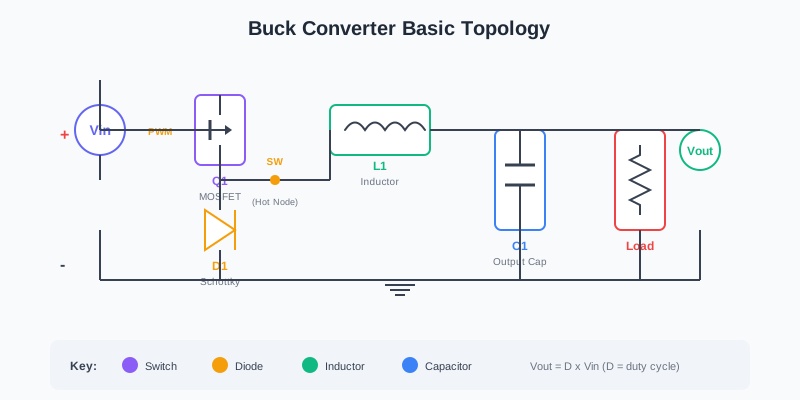
Basic buck converter topology with key components labeled
Core Components
A buck converter consists of four essential components:
- Switch (Q1): Typically a MOSFET that rapidly turns on and off at high frequency (100kHz to several MHz)
- Diode (D1): Freewheel/catch diode that provides an alternate current path when the switch is off
- Inductor (L1): Energy storage element that smooths the current and maintains continuous power delivery
- Capacitor (C1): Output filter that reduces voltage ripple
How Buck Converters Work
The buck converter operates by rapidly switching the input voltage on and off, then filtering the resulting pulsed waveform through an LC filter to produce a smooth DC output. The key insight is that the average voltage depends on the duty cycle—the ratio of on-time to total switching period.
Switch ON Phase
When the MOSFET switch turns ON, current flows from the input source through the inductor to the load. During this phase:
- The diode is reverse-biased (cathode voltage higher than anode)
- The inductor stores energy in its magnetic field
- Inductor current ramps up linearly with slope:
(V_in - V_out) / L - Energy transfers from input to both the inductor and the load
Switch OFF Phase
When the switch turns OFF, the inductor opposes any sudden change in current by inducing a voltage that forward-biases the diode:
- The inductor "kicks back," forcing current through the diode
- Stored magnetic energy is released to the load
- Inductor current ramps down linearly with slope:
-V_out / L - The cycle repeats at the switching frequency

Inductor current and voltage waveforms during switching operation
Operating Modes (CCM vs DCM)
Buck converters operate in two distinct modes depending on the load current:
Continuous Conduction Mode (CCM)
- • Inductor current never reaches zero
- • Preferred for high-power applications
- • Predictable, easier to control
- • Lower peak currents, lower EMI
- • Larger inductor required
Discontinuous Conduction Mode (DCM)
- • Inductor current reaches zero each cycle
- • Common at light loads
- • Smaller inductor possible
- • Higher peak currents, more EMI
- • Variable frequency control often used
Design tip: For most applications, design for CCM operation at maximum load. This provides predictable behavior and lower component stress. Some modern controllers automatically switch between CCM and DCM (pulse-skipping mode) for improved light-load efficiency.
Synchronous vs Asynchronous Buck Converters
The choice between synchronous and asynchronous topologies significantly impacts efficiency, cost, and complexity:
| Feature | Asynchronous | Synchronous |
|---|---|---|
| Low-Side Element | Schottky Diode | MOSFET |
| Typical Efficiency | ~80-85% | ~90-95% |
| Cost | Lower | Higher |
| Complexity | Simpler | More complex (dead time control) |
| Low Voltage Output | Poor (diode drop ~0.3-0.5V) | Excellent |
| Best For | Simple, low-cost designs | High efficiency, low V_out |
Key insight: At high step-down ratios (e.g., 12V to 1.5V), the low-side switch conducts for ~90% of each cycle. With a diode's 0.5V forward drop, you lose 33% of the output voltage as heat! A synchronous MOSFET with 5mΩ R_DSon carrying 10A only drops 50mV—a massive efficiency improvement.
Key Design Equations
Duty Cycle Calculation
The fundamental relationship between input and output voltage is:
D = V_out / V_in
For example, stepping 12V down to 5V requires: D = 5/12 = 0.417 or 41.7% duty cycle.
In practice, account for voltage drops across the switch, diode (if asynchronous), and inductor DCR:
D = (V_out + V_diode + V_inductor) / (V_in - V_switch)
Inductor Selection
The inductor is the heart of the buck converter. Proper selection ensures stable operation, low ripple, and high efficiency.
Inductance Formula
The inductance value determines the ripple current magnitude:
L = (V_in - V_out) × D / (ΔI_L × f_sw)
Where:
- V_in = Input voltage (V)
- V_out = Output voltage (V)
- D = Duty cycle
- ΔI_L = Inductor ripple current (A peak-to-peak)
- f_sw = Switching frequency (Hz)
Ripple Current Selection
Choose the ripple current as a percentage of maximum output current. Industry practice is 20-40% of I_out(max):
ΔI_L = r × I_out(max)
where r = 0.2 to 0.4 (ripple ratio)
Design Trade-off
Lower ripple (r = 0.2): Larger inductor, lower EMI, better transient response
Higher ripple (r = 0.4): Smaller inductor, faster response, higher peak currents
Optimal: Target r = 0.3 for a good balance (the "knee" of the size/performance curve)
Saturation Current Rating
The inductor's saturation current (I_sat) must exceed the peak inductor current:
I_peak = I_out + ΔI_L/2
Select: I_sat > I_peak × 1.2 (20% margin)
Critical: Select an inductor with saturation current rating that exceeds the switching current limit of your controller, not just the maximum load current. This prevents saturation during transients and startup.
Capacitor Selection
Output Capacitor
The output capacitor determines voltage ripple and transient response. Calculate minimum capacitance for desired ripple:
C_out = ΔI_L / (8 × f_sw × ΔV_out)
Where ΔV_out is the desired peak-to-peak output voltage ripple.
For transient response (load step), also consider:
C_out = (ΔI_out)² × L / (2 × V_out × V_os)
Where ΔI_out is the load step and V_os is the acceptable output voltage overshoot.
Input Capacitor
Input capacitors handle the pulsed current drawn by the buck converter. Key requirements:
- RMS current rating: Must handle high ripple current (typically > 0.5 × I_out)
- Low ESR: Reduces input voltage ripple and power loss
- Low ESL: Minimizes voltage spikes during switching
- Placement: As close as possible to the IC and high-side switch
ESR and ESL Considerations
The total output ripple consists of capacitive ripple plus ESR ripple:
ΔV_total ≈ ΔI_L × ESR + ΔI_L / (8 × f_sw × C)
Practical Tip
Use X7R or X5R MLCC ceramics for low ESR/ESL. Be aware of DC bias derating—a 10µF ceramic at 5V bias might only provide 6-7µF actual capacitance. Always check the manufacturer's DC bias curves and add margin.
MOSFET Selection
Key MOSFET Parameters
For buck converter MOSFETs, focus on these critical parameters:
| Parameter | Importance | Selection Guideline |
|---|---|---|
| V_DS(max) | Voltage rating | > V_in × 1.5 for margin |
| R_DS(on) | Conduction losses | As low as possible for efficiency |
| Q_g (Gate charge) | Switching losses | Lower = faster switching, less loss |
| I_D(max) | Current handling | > 2 × I_out(max) |
| C_oss | Output capacitance | Lower = less switching loss |
High-side vs Low-side FET trade-off: High-side FETs benefit more from low R_DS(on) (longer on-time at low duty cycles), while low-side FETs in synchronous converters need fast body diode recovery or external Schottky diodes.
Gate Driver Selection
The gate driver must rapidly charge and discharge the MOSFET gate capacitance. Key specifications:
- Source/Sink current: Higher current = faster switching (typical: 1-4A)
- Rise/Fall time: Faster = lower switching losses, but more EMI
- Bootstrap capability: For high-side N-channel MOSFETs
- Under-voltage lockout (UVLO): Prevents partial MOSFET turn-on
Dead Time Configuration
In synchronous buck converters, dead time prevents both MOSFETs from conducting simultaneously (shoot-through):
- Too short: Risk of shoot-through, high cross-conduction losses
- Too long: Body diode conduction losses, reduced efficiency
- Typical values: 50-150ns for silicon MOSFETs
- GaN devices: Can use shorter dead times (no body diode recovery)
Warning: Shoot-Through
If both high-side and low-side MOSFETs turn on simultaneously, a short circuit forms from V_in to GND. This causes massive current spikes, heat, and can destroy the MOSFETs instantly. Always ensure adequate dead time!
Popular Buck Converter ICs
Here are some commonly used buck converter ICs, from hobbyist modules to professional designs:
| IC | V_in Range | I_out | f_sw | Type | Best For |
|---|---|---|---|---|---|
| LM2596 | 4.5-40V | 3A | 150kHz | Async | Hobbyist, simple |
| MP1584EN | 4.5-28V | 3A | 1.5MHz | Sync | Small size, modules |
| TPS561208 | 4.5-17V | 1A | 580kHz | Sync | Low-power, efficient |
| LM5116 | 6-100V | External | 50-1000kHz | Controller | High voltage, flexible |
| TPS54302 | 4.5-28V | 3A | 400kHz | Sync | Professional designs |
Module Warning
Cheap buck converter modules (LM2596, MP1584) often use poor quality electrolytic capacitors and may not deliver their rated current. The MP1584 modules, for example, typically only handle 1.5A reliably despite being labeled "3A." For serious projects, design your own board with quality components.
PCB Layout Best Practices
A poorly laid out buck converter can suffer from excessive EMI, instability, poor efficiency, or even failure. Follow these critical guidelines:
Component Placement
- Input capacitor first: Place as close as possible to the IC on the same layer
- Keep the hot loop small: The path from input cap → high-side switch → inductor → low-side switch → input cap ground should be minimal
- Inductor placement: Close to IC, same layer, avoid placing under or near sensitive analog circuits
- Output capacitor: Near the inductor output and load connection point
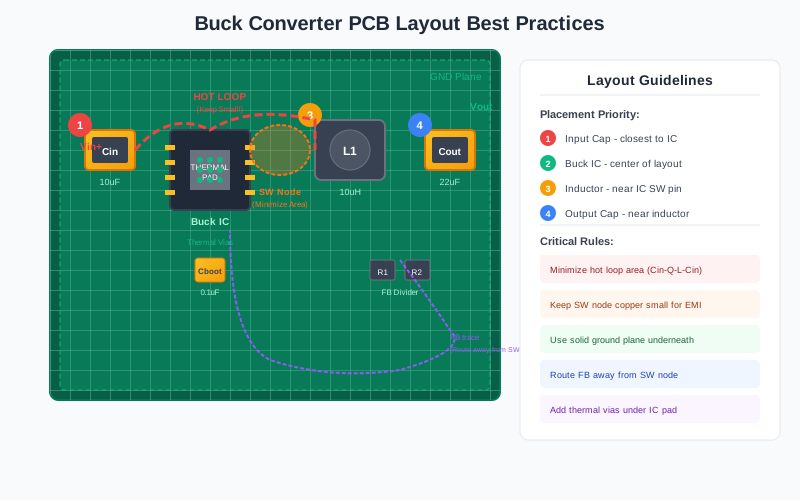
Recommended PCB layout showing component placement and critical current loops
Routing Guidelines
- Minimize via usage: Each via adds inductance (~0.5-1nH). Keep power components on one layer
- Wide, short traces: For power paths, width reduces resistance; short length reduces inductance
- Avoid right angles: Use 45° corners or curves to prevent reflections
- Feedback routing: Keep far from switching node and inductor; route on opposite side of board if possible
- Ground plane: Use a solid ground plane beneath the converter for low impedance return paths
EMI Reduction Techniques
- Minimize switching node area: The "hot node" between high-side switch and inductor radiates EMI—keep it small
- Add input filtering: Pi-filter (C-L-C) at power entry for conducted EMI
- Use ferrite beads: On feedback lines and sensitive signals
- Shield the inductor: Shielded inductors contain magnetic fields better
- Consider slew rate: Gate resistors (10-100Ω) can slow switching for EMI vs. efficiency trade-off
Thermal Design
Power dissipation in buck converters occurs in the switches (conduction and switching losses), inductor (DCR and core losses), and to a lesser extent capacitors (ESR losses).
Power loss estimation:
- MOSFET conduction: P = I_rms² × R_DS(on)
- MOSFET switching: P ≈ 0.5 × V_in × I_out × (t_rise + t_fall) × f_sw
- Inductor DCR: P = I_rms² × DCR
- Diode (async): P = V_f × I_avg × (1-D)
Thermal design tips:
- Use exposed pad packages (QFN, PowerPAD) with thermal vias to ground plane
- Provide adequate copper area for heat spreading
- Keep junction temperature below 125°C (preferably under 100°C for reliability)
- Consider derating at high ambient temperatures
Troubleshooting Common Issues
1. Converter Won't Start
Causes: Input undervoltage, excessive output capacitance causing current limit, enable pin not high, soft-start issues
Fix: Check V_in vs. UVLO threshold, verify enable pin, reduce output cap or increase current limit
2. Excessive Output Ripple
Causes: Inductance too low, output capacitance too low, high ESR capacitors, poor layout
Fix: Increase L or C_out, use low-ESR ceramics, check probe technique (use tip-and-barrel method)
3. Oscillation/Instability
Causes: Compensation issues, C_out ESR outside stable range, poor layout causing parasitic inductance
Fix: Check compensation network, verify C_out ESR meets datasheet specs, review feedback routing
4. Low Efficiency
Causes: High R_DS(on) MOSFETs, high DCR inductor, excessive switching frequency, diode forward drop
Fix: Use lower R_DS(on) FETs, lower DCR inductor, reduce f_sw if possible, switch to synchronous topology
5. MOSFET Failures
Causes: Overvoltage spikes, shoot-through, excessive temperature, insufficient gate drive
Fix: Add snubber, increase dead time, improve thermal design, verify gate driver voltage
6. EMI Problems
Causes: Large switching node area, long traces, poor grounding, unshielded inductor
Fix: Minimize hot loop, use shielded inductor, add input filter, review layout
Complete Design Example
Let's design a buck converter with these specifications:
- V_in: 12V (typical battery or wall adapter)
- V_out: 5V
- I_out: 2A maximum
- ΔV_out: < 50mV peak-to-peak ripple
- f_sw: 500kHz
Step 1: Duty Cycle
D = V_out / V_in = 5V / 12V = 0.417 (41.7%)
Step 2: Inductor Selection
Choose ripple ratio r = 0.3 (30% of I_out):
ΔI_L = 0.3 × 2A = 0.6A peak-to-peak
L = (V_in - V_out) × D / (ΔI_L × f_sw)
L = (12 - 5) × 0.417 / (0.6 × 500,000)
L = 2.92 / 300,000 = 9.7µH
Select: 10µH inductor
Peak current: I_peak = 2 + 0.6/2 = 2.3A. Select inductor with I_sat > 3A for margin.
Step 3: Output Capacitor
C_out = ΔI_L / (8 × f_sw × ΔV_out)
C_out = 0.6 / (8 × 500,000 × 0.05)
C_out = 0.6 / 200,000 = 3µF minimum
Select: 22µF ceramic (10µF effective after DC bias) + 100µF electrolytic
Step 4: Input Capacitor
For input capacitor, ensure it can handle the RMS current (~0.5 × I_out = 1A RMS). Select 10µF ceramic with 25V rating minimum (12V × 1.5 = 18V for margin).
Step 5: Component Summary
| Component | Value | Key Specifications |
|---|---|---|
| Inductor | 10µH | I_sat > 3A, DCR < 50mΩ, shielded |
| C_out (ceramic) | 22µF | 10V rated, X5R or X7R |
| C_out (bulk) | 100µF | 10V, low ESR electrolytic |
| C_in | 10µF | 25V rated, X5R or X7R |
| Controller IC | TPS54302 | 3A sync buck, integrated FETs |
Frequently Asked Questions
Q: Why use a buck converter instead of a linear regulator?
Buck converters achieve 85-95% efficiency compared to 30-60% for linear regulators. At high current or large voltage drops, linear regulators waste significant power as heat. For example, stepping 12V to 5V at 2A: a linear regulator dissipates (12-5) × 2 = 14W as heat, while a 90% efficient buck converter only dissipates ~1W.
Q: What switching frequency should I use?
Higher frequency (500kHz-2MHz) allows smaller L and C but increases switching losses and EMI. Lower frequency (100-300kHz) uses larger components but is more efficient and has less EMI. For most applications, 200kHz-500kHz is a good compromise. Stay below 1MHz unless you need very small size.
Q: Can I use any inductor with the right value?
No! The inductor must be designed for power applications with low DC resistance (DCR), adequate saturation current (I_sat > peak current), low core losses at your switching frequency, and appropriate current rating. Audio or RF inductors will overheat or saturate.
Q: Why is my output voltage slightly off?
Common causes: feedback resistor tolerance (use 1% or better), reference voltage variation, load regulation effects, or voltage drops not accounted for. For precision applications, use a potentiometer for fine adjustment or tighter tolerance feedback resistors.
Q: How do I measure output ripple correctly?
Use the "tip and barrel" method: remove the ground clip from your oscilloscope probe and use a short ground spring directly to the output capacitor ground. Long ground leads pick up switching noise and show false ripple. Bandwidth limit (20MHz) can help see the actual ripple.
Conclusion
Buck converter design is a fundamental skill for any electronics engineer working with power systems. While the basic concept is straightforward—switch, filter, regulate—the details of component selection, thermal management, PCB layout, and EMI mitigation make the difference between a mediocre design and a reliable, efficient one.
Key takeaways from this tutorial:
- Choose synchronous topology for high efficiency, especially at low output voltages
- Size inductors for 20-40% ripple current with adequate saturation margin
- Use low-ESR ceramic capacitors and account for DC bias derating
- Layout is critical: minimize the hot loop, keep feedback traces away from switching nodes
- When troubleshooting, check the basics first: input voltage, enable pin, soft-start timing
Ready to Design Your Buck Converter?
Use Schemalyzer to analyze your EasyEDA schematics and catch potential issues before they become problems. Our AI-powered analysis can help identify component value errors, layout concerns, and design rule violations.
Further Reading
- PCB Design for Beginners - Layout fundamentals
- Complete EasyEDA Tutorial - Design your PCB
- Texas Instruments SLVA477 - Basic Calculation of a Buck Converter's Power Stage
- Würth Elektronik ANP017 - DC-DC Converter Design Guide